Hearing Test
Free Online Hearing Test
By Dan McCoy, Audiology Industry Professional · Updated June 2026
If you're here, you already suspect something has changed. This test won't diagnose you — but it will tell you whether what you're noticing is worth taking seriously. Five minutes, no appointment, no cost. The free hearing test most people take before their first audiology appointment.
Free account - no credit card required.
How It Works
What to Expect
What is a Hearing Test?
A hearing test (audiometry) plays tones at different pitches and volumes to find the quietest sound you can detect at each frequency. Results are plotted on an audiogram and classified as normal, mild, moderate, or significant hearing loss.
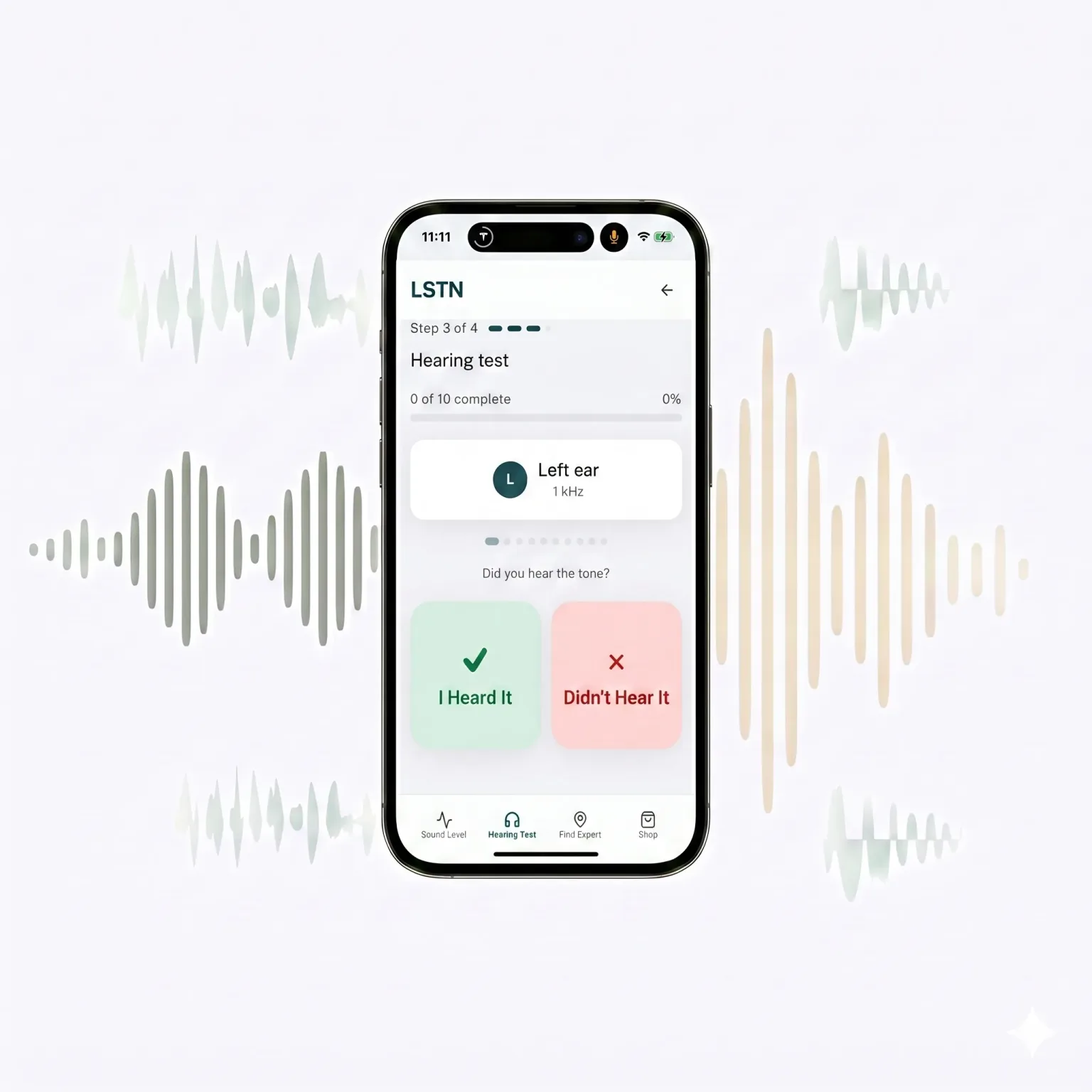
Find a quiet spot and grab a pair of headphones — we have a calibrated list, but any pair will work. You'll listen for tones at different frequencies and volumes, and we'll calculate your results from there. At the end you get a full audiogram and your Hearing Number.
Want a full walkthrough before you start? Read our step-by-step guide to taking an online hearing test.
Put on headphones
Use over-ear or in-ear headphones in a quiet room. Avoid using phone or laptop speakers.
Listen for tones
You will hear a series of pure tones at different pitches and volumes. Tap when you hear one.
Get instant results
Your hearing threshold at each frequency is plotted and classified. Results are saved to your account.
Who It Helps
Is This Test For You?
You suspect you might have hearing loss
A screening result is a useful first step before deciding whether to see an audiologist.
You want a baseline before a professional visit
Bring your LSTN results to your appointment as a conversation starter with your audiologist.
You had a hearing test and want to track changes
Repeat the screening over time to see whether your threshold is stable or shifting.
A family member is concerned about your hearing
A five-minute screening is often the first step to starting a conversation about next steps.
Understanding Your Results
What the Classifications Mean
Hearing thresholds are measured in decibels (dB HL). The quieter the sound you can detect, the better your hearing. Results are grouped into these categories per American Academy of Audiology (AAA) classification standards:
Normal
0 - 25 dB
You can detect sounds at typical conversational volumes across all key frequencies. No action required.
Mild Loss
26 - 40 dB
You may miss quiet speech or struggle in noisy environments. A professional evaluation is a good idea.
Moderate Loss
41 - 55 dB
You likely miss much of a normal conversation. Hearing aids and a professional evaluation are recommended.
Significant Loss
56 dB+
You are missing a substantial portion of speech. A professional evaluation and hearing aids are strongly recommended.
If your result shows any degree of hearing loss, the next step is a professional evaluation. Find an audiologist near you.
Already have a clinical audiogram from a previous appointment? Upload it for a plain-English explanation of your results.
Other free tools: measure the sound levels around you or try live speech-to-text transcription.
Source: American Academy of Audiology — Managing Hearing LossAn Honest Note
What an Online Test Can and Cannot Do
An online hearing test taken with good headphones in a quiet room gives a reliable screening result. It is accurate enough to indicate whether your hearing is within normal range or whether further evaluation is worth pursuing.
It cannot replicate a clinical audiological evaluation in a sound-treated booth with insert earphones and the precise calibration of professional audiometric equipment. If you are concerned about your hearing, a formal diagnosis requires a licensed audiologist.
LSTN is a hearing screening tool. It is not a medical device and does not provide medical diagnoses.
Common Questions
Hearing Test FAQ
How accurate is an online hearing test?
What equipment do I need?
What is a BPTA hearing test?
What should I do if my result shows hearing loss?
Is the test free?
Ready to Check Your Hearing?
Takes under five minutes. Free account, results saved permanently. No credit card needed.