Sound Level Meter
Measure Noise Before It Damages Your Hearing
By Dan McCoy, Audiology Industry Professional · Updated June 2026
Measure the noise around you in real time — so you know when to protect your hearing before it's too late. Some people find themselves using the meter to check whether there's sound in the room at all, not just whether it's too loud. If that's you, the free hearing test is a good next step.
Free account - microphone access required.
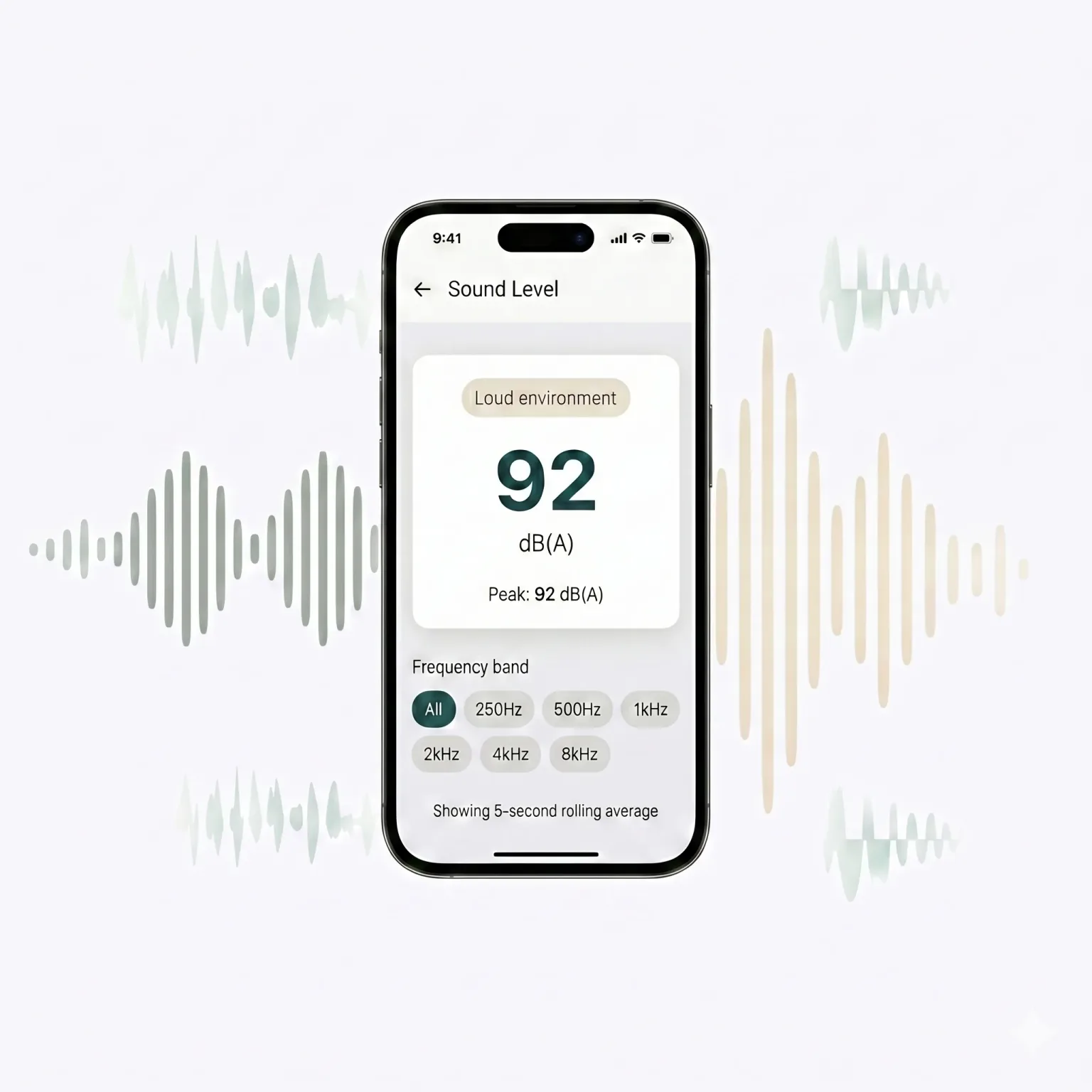
Know the Numbers
Common Sound Levels and Their Risks
What is a Sound Level Meter?
A sound level meter measures the intensity of sound in decibels (dB) in real time. It shows how loud your environment is, helping you identify when noise levels are high enough to cause permanent hearing damage with prolonged exposure.
Sound is measured in decibels (dB). The scale is logarithmic — every 10 dB increase represents a tenfold increase in sound intensity. The damage potential grows dramatically with small increases in volume.
The exposure limits below are based on NIOSH (National Institute for Occupational Safety and Health) guidelines, which use a 3 dB exchange rate — the standard for hearing damage risk assessment.
30 dB
Quiet library, whisper
Safe at any duration
60 dB
Normal conversation
Safe at any duration
75 dB
Busy restaurant, vacuum cleaner
Safe for extended periods
85 dB
Lawnmower, heavy city traffic
Safe for up to 8 hours
91 dB
Motorcycle, power drill
Safe for up to 2 hours
100 dB
Nightclub, concert
Safe for up to 15 minutes
110 dB
Live music near speakers
Safe for under 2 minutes
120 dB+
Jet engine, gunshot
Immediate damage risk
Concerned about years of noise exposure? LSTN's free hearing test screens for noise-induced hearing loss in under five minutes.
Also struggling to follow conversations in loud places? Try live speech-to-text transcription.
How It Works
Real-Time Decibel Measurement
LSTN uses your device's microphone with A-weighting (dBA) — the same standard used in occupational health guidelines. This matches how human hearing perceives different frequencies and reflects real-world damage risk more accurately than unweighted measurements.
Open the meter
Launch LSTN on any device and open the Sound Level Meter. Grant microphone access when prompted.
Point at the source
Hold your phone toward the sound source. The meter updates continuously with the current dBA reading.
Know when to protect
Readings above 85 dBA signal that ear protection is appropriate. Use the result to decide whether to stay, reduce volume, or use earplugs.
Where to Use It
Environments Worth Measuring
Concerts and live music
Venues regularly exceed 100 dB near the speakers. Even 15 minutes at this level can cause lasting damage.
Workplaces
OSHA requires hearing protection above 90 dB for 8-hour exposures. Measure your workspace to know whether you qualify.
Home power tools
Drills, saws, and leaf blowers often exceed 90-100 dB. Short exposure without ear protection adds up over a lifetime.
Restaurants and bars
Loud dining environments can reach 80-90 dB. Worth measuring if you go regularly, especially if you already have hearing loss.
Children's environments
Toy sirens and children's headphones can exceed safe levels. Measure before letting children use audio devices at high volume.
Sporting events
Stadiums can reach 100+ dB during peak crowd noise. Regular attendance without ear protection carries cumulative risk.
Common Questions
Sound Level Meter FAQ
How loud is too loud?
Can I use my phone as a sound level meter?
What is A-weighting (dBA)?
Does noise damage hearing permanently?
What if the meter shows loud sounds I can barely hear?
What type of hearing protection should I use?
Measure Your Environment Now
Free account, real-time decibel readings, no credit card required.